

• Walk through my go-to exercises here

  • Sing along to this 10 minute Warm-Up Track here

  • Tips For Faster Improvement here

  • Want to get your singing questions answered? Send me a note and I’ll get back to you! Contact me here

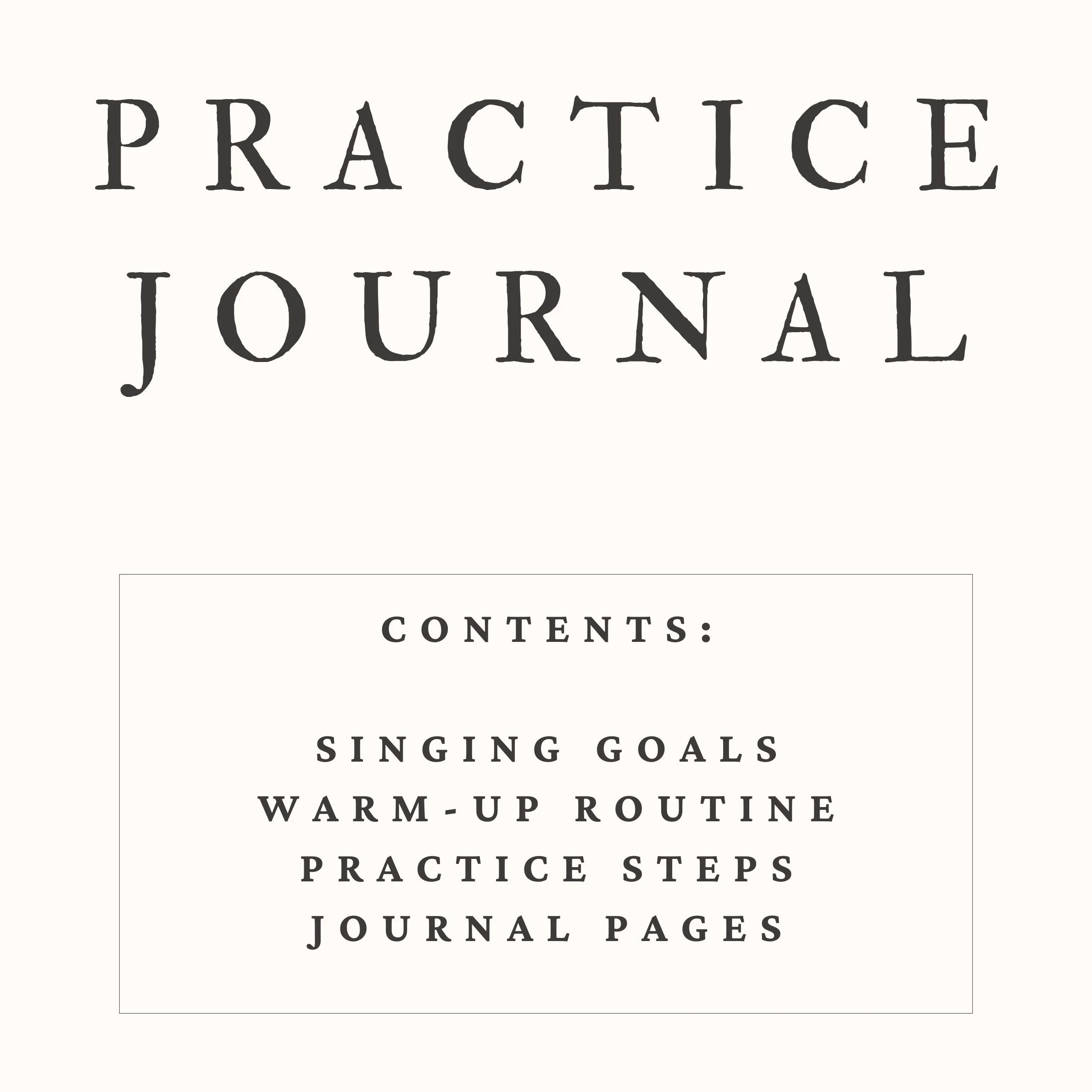
  • Download my free Practice Journal here

Singing Exercises

Singing exercises and warm-ups help build vocal strength, muscle memory, ear-training, and more.

Here are my favorites!

Exercise #1

SOVT’s

SOVT exercises are the perfect start to your warm-up because they are gentle on the vocal folds. They train the breath, resonance, range, register transitions, vocal recovery, and more.

What are SOVT exercises?

SOVT stands for Semi-Occluded Vocal Tract.

This means that we are phonating while our mouth is almost or completely closed.

SOVT exercises create back pressure. Because our mouth is closed, airflow supports our vocal folds above and below our cords while we make a sound.

Try this SOVT exercise below with the practice track!

Exercise #2

Slides

Sliding is a way to navigate your vocal registers and iron out transitions between low, middle, and high. When we slide, we learn how to modify our vowels, breath, and intensity as we move through our full range.

Try this sliding exercise below with the practice track!

Exercise #3

Vowel Focus

Shaping our singing vowels intentionally helps us create our desired tone.

Vowels help shape our vocal tract. To gain control over the shape of our instrument, we build awareness and do exercises that train our tongue, jaw, lips, and soft palate.

In general, our jaw and tongue are relaxed, the soft palate is lifted, and the mouth is open and in an exaggerated vowel shape. (Compared to when we speak.)

Try this vowel-focused exercise below with the practice track!

Mi, Me, Mah, Mo, Mu (or) Mee, May, MAH, Moe, Moo

Exercise #4

Sing in “Head Voice”

Lifting your soft palate is essential to access your head voice or falsetto. Lifting the soft palate gives you more space in the oral cavity, giving your voice more room for resonance, balances your tone, and opens the door for vibrato.

Try this head voice exercise below with the practice track!

Exercise #5

Sing in “Mixed Voice”

Mixed voice can ease breaks between registers and give you a bright, sometimes belt-y sound.

Mixed voice combines the relaxed larynx and soft palate of our chest voice with the gently stretched vocal folds of our high voice. the mix typically requires less breath pressure, a speaking volume, and feels effortless.

Oral twang is necessary for finding the mix. Nasal resonance also helps, but too much nasality can cause issues if overused.

Try this mixed voice exercise below with the practice track!

Exercise #6

Sing in “Chest Voice”

The chest voice may be similar to your resting speaking voice. When you sing in your chest voice, you’ll relax your tongue, lift your soft palate slightly, and engage your breath more than when you speak, but the sensation is similar to speaking

Try this chest voice exercise below with the practice track!

Exercise #7

Agility

For those faster moving notes, we need to prepare our breath to engage in a way that pulses with our riffs and runs.

Try this agility exercise below with the practice track!

Exercise #7

Ear Training

We train our ears to:

  • hear notes and rhythms accurately,

  • predict the next note we sing (audiation),

  • understand harmony versus melody,

  • and instill the relationship between intervals, chords, and more.

Intentionally doing ear training exercises strengthens one of our greatest superpowers as singers. Being a good listener.

An effective way to train your ear is to consistently sing scales and be able to pick out notes in a chord, challenge your ability to predict notes, or improvise singing patterns.

Start by singing and learning the

Major Scale

(The Do Re Mi’s)

Practice with the track below!

Do, Re, Mi, Fa, So, La, Ti, Do

Do, Ti, La, So, Fa, Mi, Re, Do

Intervals

Practice singing these Intervals with the track below.

The Interval Song

Do Re, Major Second

Do Mi, Major Third

Do Fa, Perfect Fourth

Do So, Perfect Fifth

Do La, Major Sixth

Do Ti, Major Seventh

Do Do, Perfect Octave

Exercise #8

Minor Scale

Much of our focus as beginning musicians is learning the common major scale (Do Re Mi Fa Sol La Ti Do). However, the major scale is not the only type of musical structure that exists.

Some describe the minor scale as sounding “moody,” “spooky,” or “sad.” (Think of songs like “Sweet Dreams Are Made of This” by the Eurythmics or “House of the Rising Sun” by The Animals.)

The structure of the minor scale is slightly different from the major scale. In a minor chord, for instance, the 3rd of the scale is a half step lower.

Doing a minor scale warm-up or exercise will keep us flexible, so we don’t get stuck training in one mode. We want to be able to adapt easily to all kinds of songs and intervals.

Sing and learn the

Natural Minor Scale

Practice with the track below!

La, Ti, Do, Re, Mi, Fa, So, La

La, So, Fa, Mi, Re, Do, Ti, La

You can get all of this info in PDF form in my downloadable Practice Journal

10 Minute

Warm-Up

The beauty of this little warm-up is it’s right there on YouTube.

Save it to your singing warm-up playlist for daily practice!

Tips For Faster Improvement

Do what feels good

Don’t like that warm-up? I just gave you permission to skip it. Every singer is different. Your voice is like a fingerprint! Some exercises and warm-ups will feel good and some will NOT. This is normal. Singing requires us to connect the mind and body. Listen to your body and participate in exercises that challenge you, but avoid exercises that feel strained. If you struggle with straining and finding warm-ups that feel good, I made this video for you.

Nail down the basics

Ask yourself: Do I have a basic understanding of my vocal range? Am I able to sing in tune? Do I have a sense of rhythm? If you’re not sure, that’s totally okay. That is what I am here for. Exploring your voice is A LOT easier when you have a handle on the basics. If you need help with singing in tune, this video may help you! I also have a video that breaks down vocal range.

Explore and uncover your voice

You can feel secure in your voice without learning to read music. In my voice lessons with students, we develop a shared language over time. We attach words like chest voice, mixed voice, and head voice to the styles you access in your voice. Attaching vocabulary to your range, style, and sound can accelerate the process. Why? It gives your brain something to attach those sensations and sounds to. In this playlist, I break down how to find your sound.

“Begin with the end in mind.” - Dr. Stephen Covey

If you’re struggling and don’t know where to start, determining your singing goals will help. This helps narrow down what type of instruction you need and the exercises to focus on. Too often I see students stuck because of information overload. (Totally valid.) Here are some questions to ask yourself: Do I just want to improve my tone? Sing at karaoke? Audition for a musical? What type of singer do I want to be? (P.S.: If you tend to get stuck in “analysis paralysis,” I made this video for you.)

Get a second opinion

You don’t have to guess or get stuck with “information overload.” Because the sound is coming from us, it is challenging to get a clear idea of what needs attention in our singing approach. Singing lessons online are extremely effective and I see students find joy and clarity in their singing experience as quickly as one lesson. I love my job for this reason. When my students improve, I am a happy teacher! Lucky for me, I get to see this every day.

Olivia Peck, Voice Teacher

Fill out the form below to schedule a free consultation or lesson. I can’t wait to meet you!